From fragmented financial data to evidence-backed decisions.

G8 detects material financial issues, explains what changed, traces conclusions to source evidence, and guides analysts toward the next action — within a governed financial-intelligence workflow.

Detect → Explain → Trace → Act — a governed financial-intelligence workflow, not an autonomous agent.

01 / THE FINANCE PROBLEM

Finance does not lack reports. It lacks connected, investigated truth.

Source files, accounting records, operational movements, transformations, reports, and manual review usually live in separate paths. A number can reach a statement long before anyone has a practical way to inspect the source row, mapping, calculation, and approval behind it — and variance investigation stays a manual, after-the-fact chase across spreadsheets.

G8 is built to close that gap: a governed path from evidence to a detected issue, a decomposed explanation, a traceable proof, and an accountable next action.

02 / THE PRODUCT SPINE

Detect → Explain → Trace → Act.

The whole product is one motion. The system finds the issue, explains the drivers, proves each one against source evidence, and points to the next step — with deterministic numbers and a governed scope at every stage.

  1. 01

    Detect

    The system surfaces material issues on its own.

    After each governed period materialization, deterministic detectors raise findings — gross-margin deterioration, unexplained variance, location cost spikes, missing statement coverage, low-confidence investigations — into an analyst inbox, before anyone has to ask.

  2. 02

    Explain

    Each finding is decomposed, not just flagged.

    A deterministic bridge breaks a margin move into named effects — procurement price, volume, product mix, normative loss — and isolates the unexplained remainder. The numbers come from the financial engine, never from free-form generation.

  3. 03

    Trace

    Every conclusion traces to source evidence.

    Each effect drills from the statement signal down through products and locations to the underlying operational rows, with the governed scope — company, period, dataset, source — visible the whole way.

  4. 04

    Act

    The analyst is guided to the next action.

    Findings carry a recommended next step, a confidence and coverage read, a grounded investigation session, and an explicit lifecycle — new, in review, resolved, dismissed — with an owner and an audit-friendly explanation.

03 / PRODUCT EVIDENCE

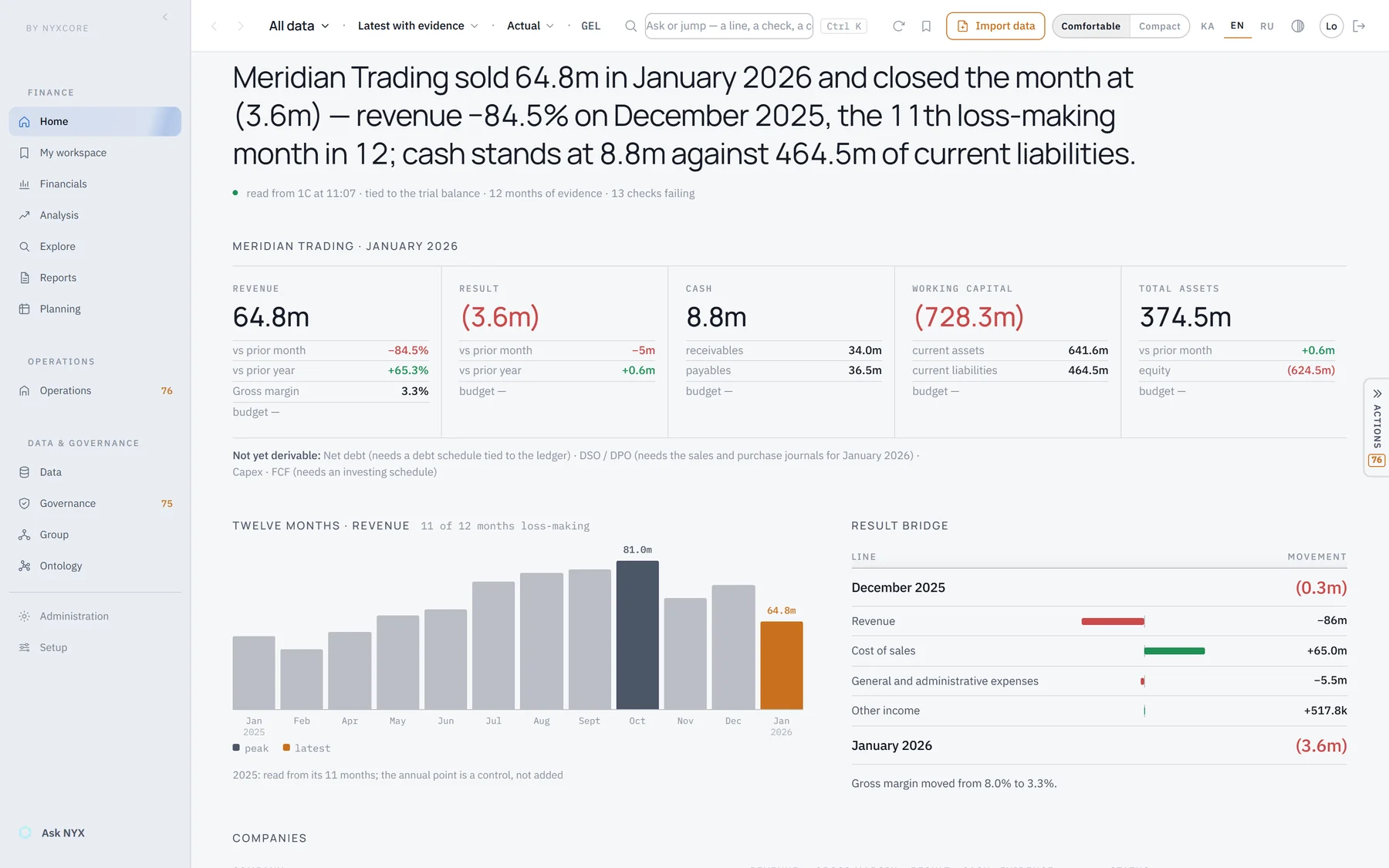
The current G8 interface.

Public-safe captures from the current G8 product experience: Financial Workbench, Database Studio, source-package exploration, statement review, and ontology graph inspection.

NYX Intelligence · Inbox

Detect · proactive findings

Gross margin deterioration-1.9 ppin review
Unexplained margin variance-2.1 ppnew
Location cost spike+ materialnew
Missing statement coveragepartialnew
Low-confidence investigationlow conf.new
Demo tenant — signals only, no client figures.
Gross-margin bridge

Explain · deterministic decomposition

-1.9 ppgross margin, period over periodconf. low · coverage shown
Procurement / unit-cost+0.6 pp
Volume-0.5 pp
Product mix+0.1 pp
Normative loss+0.6 pp
FXnot derivable
Unexplained variance-2.1 pp
Trace → product → location → source rows
Act → review largest driver; reconcile selling prices
REAL G8 INTERFACEFinancial Workbench
Current interface capture: Financial Workbench with period context, statement lines, KPIs, right-side intelligence prompts, and analyst navigation.
REAL G8 INTERFACEFinancial Database Studio
Current Financial Database Studio capture with source rows and schema context
Current interface capture: Financial Database Studio showing source packages, governed tables, schema metadata, and semantic-layer navigation.
REAL G8 INTERFACEStatement review
Current statement review workspace with KPI cards, statement lines, and G8 intelligence rail
Current interface capture: statement review surface with KPI context, statement lines, signal state, and G8 intelligence rail.
REAL G8 INTERFACESource package explorer
Current Source Package Explorer capture showing table exploration and schema context
Current interface capture: source exploration, table structure, schema context, and governed evidence surfaces.
  • governed scope (company · period · dataset) on every analysis
  • drill from a signal to the underlying operational rows
  • explicit confidence, coverage, and limitations — including honest low-confidence

04 / DIFFERENT BY DESIGN

Why this is not another dashboard.

G8 is differentiated by doing the investigation — and by keeping evidence, meaning, and control connected from source to decision.

CategoryTypical limitationG8 direction
BI dashboard

Shows what a number is, on a chart.

G8 detects the issue itself and explains why the number moved, with the drivers decomposed.

Spreadsheet

Holds the calculation but not the evidence path or governance.

G8 keeps each figure attached to source evidence, scope, and an audit explanation.

ERP reporting

Produces statements, but variance investigation stays manual.

G8 runs the investigation: detect, decompose, trace to rows, recommend the next step.

Generic chat

Answers fluently, sometimes beyond what the data supports.

G8 refuses without governed scope, never generates the numbers, and exposes an auditable explanation instead of raw reasoning.

05 / TRUST ARCHITECTURE

Financial intelligence needs more than one authority.

Governed context, explicit semantics, symbolic financial truth, and a control boundary keep every result inspectable, scoped, and able to refuse when proof is missing.

Context authority

Company, period, package, source, and active version define what may be shown or changed.

inspect

The scope boundary. Analyses refuse to run without a governed company, period, and dataset, and never mix entities, periods, or stale source versions.

CompanyPeriodPackageSourceVersion

Semantic authority

Mappings, objects, relations, and rules make financial and operational meaning explicit.

inspect

The meaning layer. Accounts, KPIs, standards, and operational objects are connected by typed relationships rather than treated as disconnected dashboard fields.

AccountKPIStandardRelationRule

Symbolic financial truth

Facts, ledgers, statements, and the deterministic engine compute every figure.

inspect

The financial-truth boundary. Numbers are computed by deterministic accounting logic; the model verbalizes and ranks, but never authors a figure or rewrites a ledger fact.

FactLedgerStatementBridgeReconcile

Action & audit authority

Roles, approvals, actor provenance, confidence, limitations, and audit events constrain action.

inspect

The control boundary. Findings carry confidence and limitations; higher-risk changes require role, approval, actor provenance, and audit evidence. The stored explanation is auditable, not raw chain-of-thought.

RoleApprovalConfidenceAuditRefusal
REAL G8 INTERFACEOntology graph
Current interface capture: ontology connector types, reasoning modules, node inspector, and connector trace.

06 / ADAPTIVE-LEARNING ARCHITECTURE

Governed adaptive learning — described honestly.

G8 is built with a governed adaptive-learning architecture. Candidate improvements are evaluated on held-out cases, checked against regression and scope controls, and promoted only within approved boundaries. The current adaptive-learning harness has been validated in an isolated synthetic benchmark; real-ledger adaptive-learning validation remains a future milestone pending sufficient aligned operational history.

Validated on real dataThe proactive financial-intelligence workflow — detect, explain, trace, act — runs on real operational financial data.
Demonstrated in synthetic benchmarkThe governed adaptive-learning harness is hardened and shown end-to-end on an isolated, leakage-controlled synthetic benchmark.
Future milestoneReal-ledger adaptive-learning validation awaits sufficient aligned operational history.

G8 does not claim autonomous learning from client financials, production neural reasoning, or a completed financial AGI. The learned layer ranks and calibrates; it never authors a figure or rewrites financial logic.

07 / INITIAL VERTICAL

Industrial & petroleum intelligence.

The most tangible vertical today is petroleum and operational finance. A bounded, persisted workflow links movement and inventory evidence to normative and unexplained loss, causal findings, recommendations, status review, and margin exposure — without automatically posting or promoting candidate truth.

movementinventorylossmargin candidate

Qualification: an initial implemented vertical, not a claim of complete petroleum ERP coverage.

Loss-to-margin · demo
Throughputillustrativedemo
Normative losswithin bandpolicy
Unexplained varianceflaggedfinding
event → location → tank → rules → narrative
governed candidate — review before posting
Demo tenant — no client operational data.

08 / PILOT

Gross Margin & Loss Intelligence Pilot.

A focused, bounded pilot proves one traceable, governed workflow on your data:

  • one company, one business unit, a few months of source data;
  • one governed ingestion path from evidence to statements;
  • margin-deterioration detection and loss-variance analysis;
  • location-level drill-down to the underlying rows;
  • the analyst inbox, evidence lineage, and feedback loop;
  • an honest read on confidence, coverage, and what cannot yet be proven.
Request a Demo

09 / IMPLEMENTED CAPABILITIES

What the current product can credibly demonstrate.

Repository-backed capabilities with qualifications shown. Agentic flows are governed analyst assistance, not autonomous finance operations.

Proactive intelligence inbox

Deterministic detectors raise material findings with scope, impact, confidence, coverage, evidence, recommended action, owner, and lifecycle.

Validated on real operational financial data

Deterministic margin & loss explanation

A governed bridge decomposes a gross-margin move into named effects and an explicit unexplained remainder, with reconciliation.

Verified end-to-end in the running product

Evidence lineage drill-down

Conclusions trace from a statement signal through drivers, products, and locations to the underlying operational rows.

Implemented across the investigation surfaces

Source-to-statement compilation

A tested chain keeps raw evidence separate from normalized facts, domain ledgers, statement packages, and export artifacts.

Implemented with scoped compiler and lineage controls

Financial semantic layer

Typed financial and operational objects, relations, rules, impact previews, and lineage give structure beyond disconnected tables.

Foundation implemented; canonical lifecycle still maturing

Governed action & audit boundary

Higher-risk actions retain role, approval, actor provenance, refusal, and audit boundaries; the persisted answer is an audit explanation, not raw model monologue.

Implemented in governed paths, with qualifications

10 / WHO IT IS FOR

Teams accountable for the number and the decision behind it.

01

Executive finance command

Leaders who need the current financial picture, material signals, trust state, and the evidence path behind a decision.

02

Close & reporting command

Teams responsible for journal integrity, statement packages, source-to-number traceability, corrections, and controlled export.

03

Finance data & systems owners

Operators who manage source packages, semantic categories, schema quality, lineage, and governed data readiness.

04

Industrial & operational finance

Teams linking movement, inventory, loss, and location-level variance back to governed financial evidence.

CONTACT

Bring one real financial workflow.

Share the process you need to make more transparent, explainable, or governable. We will focus on whether G8 is a credible fit for a demo, pilot, investment discussion, or strategic partnership.

Prefer email? connect@nyx.space

Structured inquiries are delivered through the configured form endpoint. You can also email connect@nyx.space.